How to pay Pilates instructors: flat rate or attendance bonus?

Short answer
Choose a Pilates instructor pay model by comparing the instructor’s guaranteed pay and the studio’s remaining contribution at low, expected and full attendance. A flat rate gives predictable teaching pay; a base plus attendance bonus adds upside without making every pound depend on turnout. Include preparation, administration and employment costs separately. The right amount depends on the work and local hiring market, not a universal percentage of class revenue.
A full reformer class can look healthy while the same class at four attendees barely covers its teacher. That does not mean the instructor has done less work. It means the studio needs a pay arrangement that is understandable on both days.
This guide is for owners deciding how pay should work, rather than instructors looking up earnings. For that separate question, see our US Pilates instructor salary guide. Here, all pay figures are invented planning inputs, not recommended rates or a claim about what instructors typically earn.
Which Pilates instructor pay model fits the work?
Start with what you are asking the instructor to deliver: teaching time, setup, cleaning, programming, client notes and any required meetings. Then compare the models against the same workload.
| Model | What the instructor receives | What the studio must resolve |
|---|---|---|
| Flat fee per class | The agreed amount for the defined work | Low-attendance classes still cost the same to staff |
| Hourly pay | Pay for the recorded, payable working time | Teaching hours alone may not capture all the work |
| Base plus attendance bonus | A guaranteed base and an agreed variable amount | Exactly which attendances qualify and when counts are final |
| Revenue share | An agreed share of a defined revenue amount | Discounts, memberships, refunds, a pay floor and revenue allocation |
Do not select a cheaper-looking formula before checking the actual engagement. GOV.UK explains that employment-law and tax status can differ and both need checking. Calling someone a contractor or paying per class does not settle the question. Use qualified local advice for classification, wage obligations and the agreement; this is a planning guide, not legal advice.
How do flat pay and an attendance bonus compare?
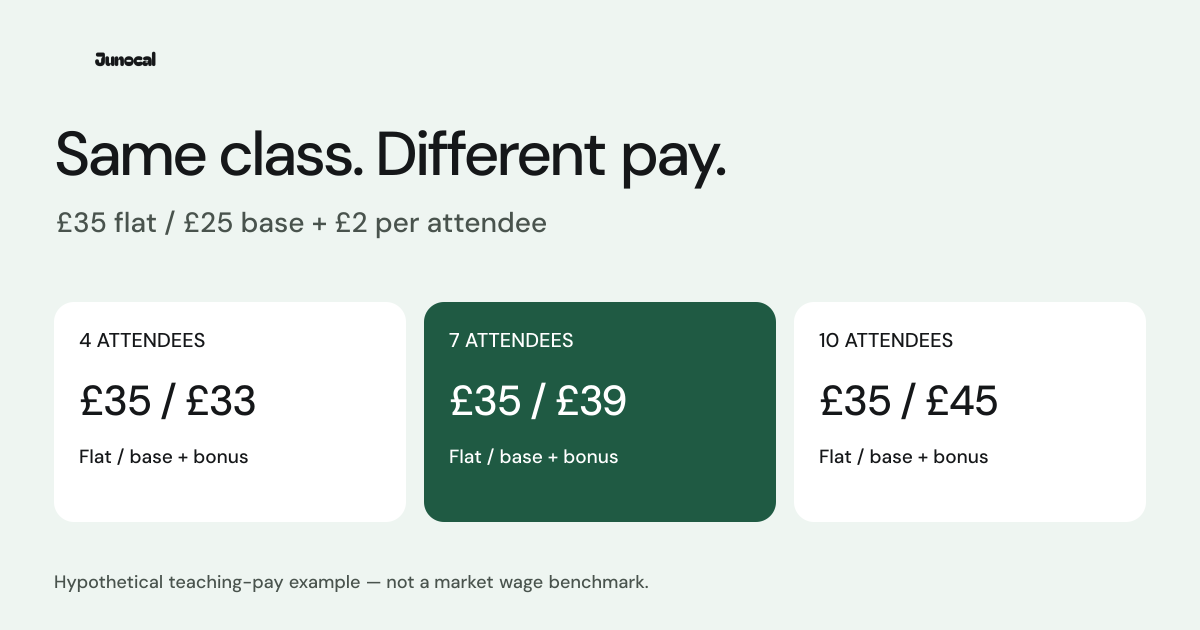
Take a hypothetical ten-place class earning £18 for each attendance. Compare £35 flat teaching pay with a £25 base plus £2 per checked-in attendee. Assume, just for this first comparison, that every attendee generates that £18 and there are no refunds or complimentary visits.
| Attendees | Class revenue | £35 flat pay | £25 + £2 per attendee | Left after flat pay | Left after base + bonus |
|---|---|---|---|---|---|
| 4 | £72 | £35 | £33 | £37 | £39 |
| 5 | £90 | £35 | £35 | £55 | £55 |
| 7 | £126 | £35 | £39 | £91 | £87 |
| 10 | £180 | £35 | £45 | £145 | £135 |
The models meet at five attendees. Below that, the base-and-bonus model pays less; above it, the teacher earns more. If your intention is to preserve £35 as a guarantee, £25 plus £2 per attendee does not do that. Change the base or introduce an explicit floor, then calculate the table again.
The last two columns are not profit. They still need to cover room costs, equipment, additional paid work, employment costs, processing, insurance, administration and the owner’s own pay. Comparing that remainder with rent alone would overstate how much the studio keeps.
How many attendees cover the class costs?
Use a contribution calculation rather than dividing wages by the public drop-in price. The SBA break-even framework separates fixed costs from the amount each additional sale contributes.
Extend our example with an illustrative £30 allocation per class for the room, other paid work and overhead, plus £1 of other cost per attendee. These are deliberately simplified totals: replace them with your fully costed numbers, including any employment on-costs.
- With flat pay: (£35 + £30) ÷ (£18 − £1) = 3.82, so four attendees cover the costs included in this model.
- With base and bonus: (£25 + £30) ÷ (£18 − £1 − £2) = 3.67, again four attendees after rounding up.
At four attendees, the flat model leaves £3 after these included costs; the bonus model leaves £5. Neither leaves much room for a missing expense. If the £30 allocation understates your actual overhead, this is not your studio’s break-even point.
For a launch, put the conservative case into your Pilates studio business plan. A full-class scenario belongs beside it, not in place of it.
Which revenue figure should you use?
Use revenue attributable to the class under a consistent method—not automatically its advertised drop-in price. A client using a discounted pack contributes a different amount from someone paying the full single-class rate.
Memberships need particular care. If £90 of monthly membership revenue covers six visits, a simple allocation gives £15 per visit. At nine visits it gives £10. That is a planning allocation, not nine separate payments. Increasing attendance can therefore change the revenue-per-visit assumption.
Before calculating pay, decide how you will handle:
- Pack credits, complimentary places and promotional prices.
- Revenue from memberships covering several different offerings.
- Refunds, late-cancellation charges and no-shows.
- Any taxes collected for the authorities and payment-processing costs, without counting a deduction twice.
- A private lesson sharing the same room and instructor time.
Keep your method visible to the instructor if their pay depends on the result. A percentage of “revenue” is not a clear agreement until both people know what that word includes.
What should the written pay worksheet include?
Use one row per session. Keep the underlying bookings and attendance records available, and make the calculation reproducible without sharing unnecessary client information.
| Field | What to record |
|---|---|
| Session | Date, time, offering and instructor |
| Work covered | Teaching plus any included setup or administration |
| Guaranteed pay | Agreed base or flat amount |
| Bonus basis | Eligible attendees, threshold, rate and any agreed floor |
| Adjustments | Approved additional work, substitute cover or cancellation pay |
| Total | Teaching pay plus adjustments, checked before payroll or invoicing |
For an attendance bonus, specify whether a paid late cancellation counts. If it does not, an instructor may receive less even though the studio collected the same revenue. If it does, the pay count will differ from the check-in count. Either distinction needs to be explicit.
Also agree when a roster is final, who can correct it and how a correction appears in the next pay period. A missing check-in should trigger a review, not an unexplained deduction.
How should you review the model after launch?
Choose a defined review period—for example, the next four teaching weeks—and compare equivalent time slots. Look at attendance, realised class revenue, all paid work and contribution after the included costs. Separate established peak-time sessions from a new class you are deliberately supporting while it builds demand.
Do not reward filling a room beyond its safe capacity or pressure instructors to teach inappropriate levels simply to increase a bonus. Capacity and suitability remain operating constraints, not variables to remove from the spreadsheet.
Agree changes prospectively. If the numbers do not work, the options include the timetable, client pricing, room costs and the offer itself—not only reducing the teacher’s pay. Our Pilates class-revenue guide helps connect those decisions to the wider business.
Where does Junocal fit?
Junocal’s Pilates studio software brings the schedule, bookings and attendance into the same operating workflow. Those records help you check what happened before reconciling pay in your separate payroll or accounting process. The examples here are not an automated Junocal payroll feature.
Start with a clear agreement and a model that works at realistic attendance. Then use your actual records to check it. That is more useful than choosing a percentage because another studio happens to use it.
FAQ
- Should a Pilates studio pay a flat rate or an attendance bonus?
- A flat rate makes teaching pay predictable. A guaranteed base plus a clearly defined bonus shares some upside. Compare both at low, expected and full attendance, include all required work and costs, and discuss the arrangement with the instructor. An attendance bonus is not evidence that someone should be treated as self-employed.
- What percentage of class revenue should go to the instructor?
- There is no universal percentage that works for every studio. Class capacity, realised revenue, preparation time, room costs and employment costs change the calculation. Test a proposed percentage against an agreed pay floor and the money needed for all remaining expenses.
- Should bonus pay use bookings or actual attendance?
- Either needs a written rule. Bookings may include cancellations and no-shows; checked-in attendance may exclude a late cancellation the studio still charges for. Define which counts, how complimentary visits are treated and how corrections are handled before the first pay period.
- Does Junocal calculate instructor payroll?
- This article’s worksheet is an independent planning example, not a payroll calculator inside Junocal. Use Junocal for the relevant schedule, booking and attendance records, and reconcile the agreed pay calculation in your payroll or accounting process.
keep reading
- How to price adult dance classes: drop-ins, packs and term feesBuild an adult dance class price menu using realistic attendance, pack discounts and course costs, with published examples and a worked pricing worksheet.
- Is a yoga studio profitable? Work out your break-even pointModel yoga studio profitability with a free calculator for membership revenue, teaching costs, owner pay and break-even attendance. See the worked example.
- How much should you charge for music lessons in 2026?Set music lesson rates using 24 US and UK providers, the 2026–27 MU guidance and a worked pricing worksheet that includes unpaid teaching time.
Run your studio on Junocal
Class-first booking, memberships, direct Stripe payments and published flat pricing for independent studios, gyms, clubs and instructors—from solo operators through ten-location groups.