How to price adult dance classes: drop-ins, packs and term fees

Short answer
Price adult dance classes by costing the teaching, room and administration at realistic attendance, then choose the payment model that fits the class. Open-level sessions can use drop-ins and packs; a beginner progression can sell as a dated course. Calculate the revenue per visit after discounts, and show exactly what each option includes. Monthly payments describe when someone pays, not necessarily the number of classes or the cancellation commitment.
A beginner ballet course, an open contemporary class and a weekly dance-fitness session do not have to use the same payment model. They ask for different commitments from the dancer and create different costs for the studio.
This guide is for adult-led studios building a clear price menu. It does not cover the extra administration of recital-led children’s schools, such as costumes or multi-child family billing. Junocal’s adult dance studio software is built around classes, course blocks, packs and memberships; the pricing plan should fit that work.
Should you sell a drop-in, a class pack or a course?
Choose the format based on how the class is taught, not simply which payment looks most attractive upfront.
| Offer | A useful fit | Make clear before purchase |
|---|---|---|
| Drop-in | Open classes where a one-off visit is suitable | Level, length, location, single-session price and cancellation rule |
| Class pack | Dancers returning to eligible open classes | Credits, eligible sessions, expiry and how each place is booked |
| Fixed-term course | A beginner progression with a defined start and finish | All dates, total price, entry level and missed-session policy |
| Membership | Regular access to a stable programme | Allowance or access limits, renewal date, exclusions and cancellation terms |
As a real example of the distinction, Danceworks separates purchasing credits from reserving a class. Its published five-class Limited package costs £57 for eligible £12 classes: £11.40 per visit. Five- and ten-class packages have a 90-day validity period; eligibility and other conditions also apply. These are one operator’s terms, not a recommended template for yours.
City Academy’s adult ballet programme instead makes progression visible through named levels, including absolute beginners, beginners and improvers. That structure is a useful reminder that a course is an educational offer, not merely a discounted pile of interchangeable visits. We are not treating these two operators as a representative pricing sample.
What does one dance class need to earn?
First calculate the session’s costs and a realistic attendance assumption. Include teaching and required preparation, room time, administration, insurance and equipment allocations. If you teach the class yourself, include an owner-pay budget: your time is not free because no invoice arrives.
Here is an invented planning example, not a market rate:
- Twelve available places in one open adult class.
- £72 of teaching, room and allocated overhead costs per session.
- £1 of additional cost per attended place.
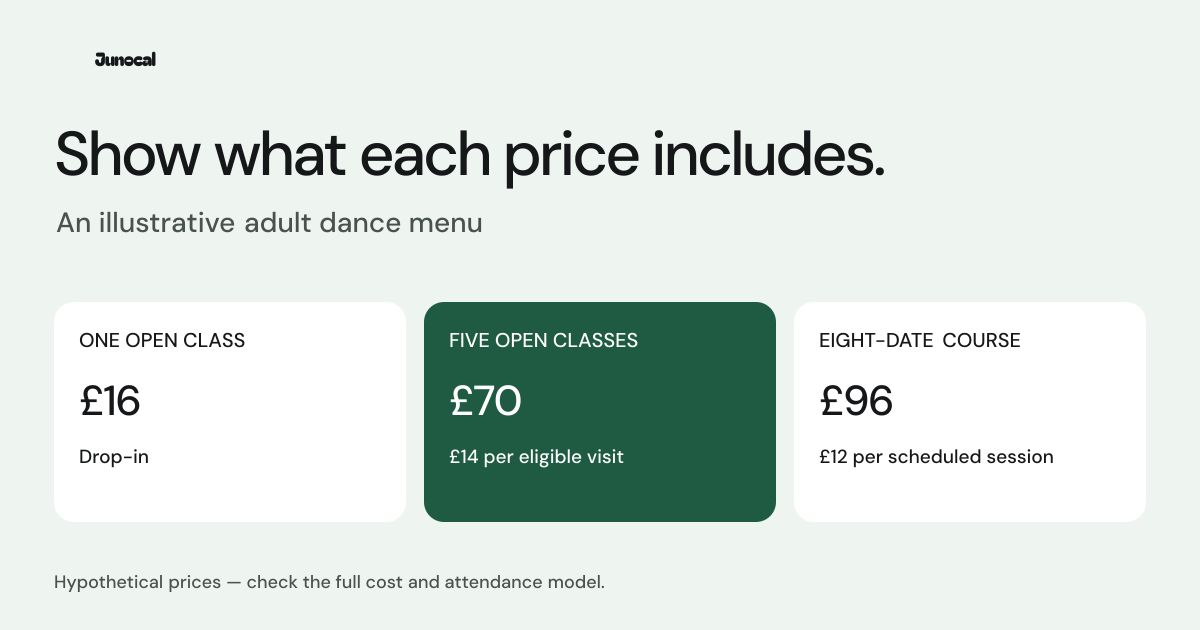
- £16 drop-in, or £70 for a five-class pack: £14 per visit.
At the pack rate, each attendance contributes £13 before the £72 session cost. Following the SBA’s break-even approach, £72 ÷ £13 = 5.54, so the model needs six paying attendees, not a full room, to cover its included costs.
| Attendees, all using the £14 pack rate | Class revenue | Included costs: £72 + £1 per attendee | Remainder after included costs |
|---|---|---|---|
| 4 | £56 | £76 | −£20 |
| 6 | £84 | £78 | £6 |
| 8 | £112 | £80 | £32 |
| 12 | £168 | £84 | £84 |
That remainder is not a promise of net profit. It depends on whether your cost allocation includes everything. Taxes, refunds, additional employment costs and any unbudgeted owner time can change the result. Replace every assumption with your own figures and do not subtract the same fee twice.
How large should the pack discount be?
Check the revenue per redeemed visit before copying a percentage discount. In our example, £70 ÷ 5 = £14 per visit, which is 12.5% below a £16 drop-in. The studio gives up £2 each time a pack credit replaces a full-price booking.
That may be worthwhile if the offer helps dancers return to places that otherwise go unused. It is less attractive if established regulars buy it for peak-time classes that already fill. Examine both cases; do not count every pack purchase as new revenue.
For planning, assume all purchased credits will be used. Relying on unused credits to make an otherwise unaffordable price work produces a fragile model. Expiry should give clients a clear, usable attendance window, and your published terms must fit the rules where you operate.
Keep the menu small enough that someone can choose without messaging you. For a first version, one drop-in, one pack and a separate beginner course may be sufficient. Our class-pack and membership pricing guide covers the broader decision about adding recurring access.
How do you price an eight-week beginner course?
Cost the entire course, including the sessions you have committed to deliver. Selling all eight dates upfront does not make an underpriced course viable.
Suppose our example studio sets an illustrative £96 course fee for eight scheduled sessions. That is £12 per session for each enrollee. With the same £72 session cost and £1 per-attendance cost, and assuming every enrollee attends every session:
- Six enrolments collect £576. Included costs are £576 + £48 = £624: a £48 shortfall.
- Seven enrolments collect £672. Included costs are £576 + £56 = £632: £40 left after included costs.
- Ten enrolments collect £960. Included costs are £576 + £80 = £656: £304 left after included costs.
Seven enrolments cover this simplified model, but provide little buffer. If the teacher needs extra course preparation or the room contract has an additional setup charge, add it before deciding the minimum enrolment. Check whether demand exists at the resulting price; cost arithmetic alone cannot establish that.
Publish the enrolment deadline, all teaching dates and what happens if you do not meet the minimum. Explain whether late joins are possible, whether missed lessons can be made up and whether a substitute instructor may teach. Do not quietly present a sequence requiring prior learning as an unrestricted drop-in.
What changes if you collect payments monthly?
Separate teaching dates, access rights and payment dates. “£32 a month” does not tell a dancer whether they are buying a rolling subscription or paying a £96 course fee in three instalments.
If you offer instalments, state the total price and number of payments beside the monthly amount. Show whether payments continue over a teaching break and what cancellation changes, subject to applicable consumer rules. Do not promise instalment collection in software until you have tested that exact workflow; a recurring membership and a course payment schedule are not automatically the same feature.
For a membership, model high usage as well as average usage. More attendance can be excellent for engagement while reducing revenue per visit. Confirm that available places can accommodate the access you are selling, especially if members tend to attend the same evening sessions.
What should appear on the booking page?
Give a dancer enough information to choose the right class without decoding your internal terminology:
- Who it is for: adult beginner, open level or a stated prerequisite.
- What they receive: one session, five credits, eight named course dates or specified membership access.
- What they pay: the total, payment timing and any separate required charge.
- How to use it: booking requirements, eligible classes and expiry where relevant.
- What happens if plans change: cancellation, missed-session and studio-cancellation rules.
Then test the purchase and confirmation as a new dancer. Buying a pack should not imply a reserved Tuesday place if a separate booking is required. A course confirmation should not leave someone guessing which dates are included.
How can Junocal help you run the offer?
Junocal’s dance studio tools support the operational pieces discussed here: class scheduling, fixed-term courses, drop-ins, packs and memberships. Set up the relevant offer, make its description and terms clear, and test the client booking journey before promotion. Check the current plans for software costs; payment processing is separate.
After launch, compare revenue per visit, attendance and repeat bookings by offer. Keep the class cost model beside those records. If a pack fills quieter sessions but erodes the revenue of full classes, that is a different result from genuinely increasing sustainable participation. The useful price is one dancers understand and the studio can afford to keep delivering.
FAQ
- How much should an adult dance studio charge per class?
- There is no single suitable rate. Work out the fully costed session, expected paying attendance and revenue retained after discounts and variable costs. Compare genuinely similar local classes by duration, level and format. Published examples are context, not a national average or a substitute for your own costs.
- Should adult dance classes use drop-ins or term fees?
- Drop-ins suit sessions where joining for one class is appropriate. A dated course can suit a beginner progression where lessons build on each other. Keep entry requirements, missed-session rules and what the course price covers visible before booking.
- How do you calculate a dance class pack discount?
- Divide the pack price by its credits, then compare that amount with the equivalent drop-in price. In our invented example, a £70 five-class pack costs £14 per visit, a 12.5% discount on a £16 drop-in. That is an illustration, not a recommended discount.
- Does paying monthly mean a dancer can cancel every month?
- Not necessarily. A monthly payment may be a rolling subscription or an instalment for a longer programme. State the total commitment, number of payments, classes included and applicable cancellation terms clearly; have terms checked for your jurisdiction.
keep reading
- How to pay Pilates instructors: flat rate or attendance bonus?Compare Pilates instructor pay models with worked class economics, an attendance-bonus example and a checklist for studio owners. No invented salary averages.
- Is a yoga studio profitable? Work out your break-even pointModel yoga studio profitability with a free calculator for membership revenue, teaching costs, owner pay and break-even attendance. See the worked example.
- How much should you charge for music lessons in 2026?Set music lesson rates using 24 US and UK providers, the 2026–27 MU guidance and a worked pricing worksheet that includes unpaid teaching time.
Run your studio on Junocal
Class-first booking, memberships, direct Stripe payments and published flat pricing for independent studios, gyms, clubs and instructors—from solo operators through ten-location groups.